
Look at any group of riders who have spent twenty years on the water and you can usually tell who protected themselves and who didn't. Deep forehead lines, leathery hands, sun spots, a squint that never fully goes away. That isn't genetics and it isn't simply age. Dermatologists call it photoaging: damage from ultraviolet light that accumulates over thousands of hours in the sun.
Kiters get a double dose. We ride in the middle of the day, in the tropics, in the wind, surrounded by a giant reflective surface. The good news: this is one of the easiest longevity wins there is, and the results show up right in the mirror.
1. Why the Water Doubles Your Dose
On land, most of your UV exposure comes straight down from the sky. On the water, it comes from every direction:
- Reflection: According to the World Health Organization, calm water reflects roughly 10% of UV, dry beach sand around 15%, and white sea foam up to 25%. Every chop line and whitecap you ride through is a mirror aimed at your chin, neck and eyes.
- Clouds don't save you: Light cloud cover lets most UV through. Grey-day sessions still burn, and because they feel cool, nobody reapplies.
- Wind hides the burn: Constant airflow keeps your skin cool, so you don't feel the warning signs until the evening. By then the damage is done.
- Salt and sweat strip protection: Wiping spray off your face, harness straps rubbing your sides, and repeated dunks all remove sunscreen far faster than the label assumes.
The Evidence: Daily Sunscreen Slows Skin Aging
In a randomized trial in Nambour, Australia (Hughes et al., Annals of Internal Medicine, 2013), adults who applied broad-spectrum sunscreen every day showed no detectable increase in skin aging over 4.5 years, and were 24% less likely to show aging progression than people who used it whenever they felt like it. Consistency, not SPF number, was the deciding factor.
2. The Kiter's Skin Protocol
Sunscreen alone isn't enough for four-hour sessions. Think in layers: fabric first, mineral block second, timing third.
Layer 1: Cover It Instead of Coating It
Fabric doesn't wash off, doesn't need reapplying, and doesn't get wiped away by your harness. A long-sleeve lycra or a thin wetsuit top protects your shoulders, arms and back for the entire session. Add a surf cap or a cap with a strap, and a neck cover if you ride in the tropics.
Why it works: The areas that age fastest on kiters (shoulders, back of the neck, forearms) are exactly the ones you can't reach to reapply mid-session.
Layer 2: Mineral Block for Everything Exposed
Use a water-resistant, broad-spectrum SPF 50 on your face, ears, neck and the backs of your hands. For the high-exposure spots (nose, cheekbones, lips, top of the ears) use a thick zinc oxide stick. It stays put through spray and crashes much better than a lotion.
Why it works: Broad spectrum means UVA protection too. UVA penetrates deep into the skin and breaks down collagen; it's the main driver of wrinkles and sagging, even when you don't burn.
Layer 3: The Reapply Rule
"Water resistant" on a label means tested for 40 or 80 minutes in the water, not all day. Keep a zinc stick in your harness pocket or tied to your pump, and reapply every time you land the kite for a drink.
Why it works: Most sunscreen failures aren't the product; they're the 3-hour session on a single morning application.
Layer 4: Don't Forget Lips and Hands
The lower lip and the backs of your hands get direct sun all session long while holding the bar. They're some of the most common places for sun damage on water-sports athletes, and they're almost always skipped.
3. Your Eyes Age Too
Skin gets all the attention, but UV and glare hit the eyes just as hard. Surfers and sailors have a name for one result: "surfer's eye" (pterygium), a fleshy growth that creeps across the white of the eye and is strongly linked to years of UV, wind and salt exposure. Long-term UV exposure is also a known risk factor for cataracts and for damage to the retina.
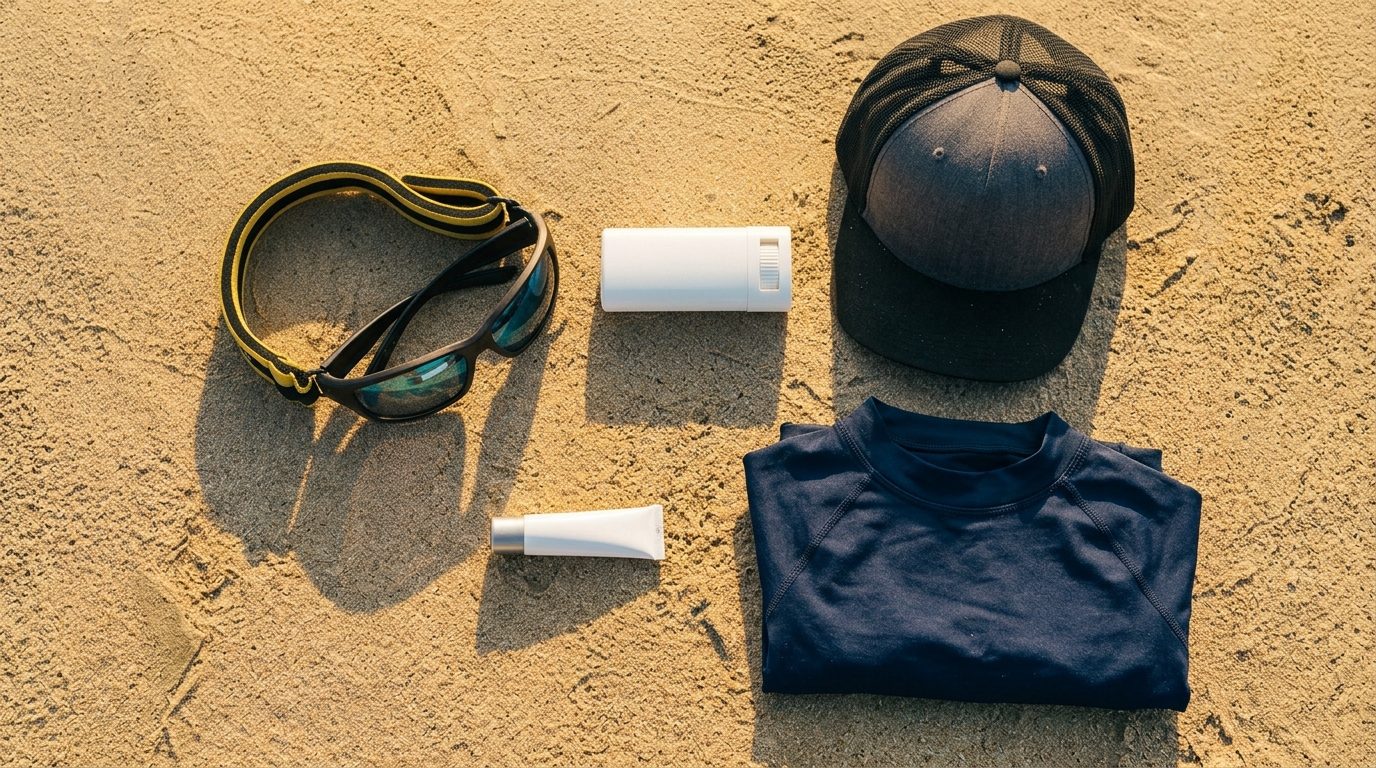
- Look for "UV400" or "100% UV protection": Polarization cuts glare (and lets you read the water and gusts better) but on its own it says nothing about UV. You want both.
- Wraparound fit: Reflected light comes in from the sides and from below. A wraparound frame blocks much more of it than flat lenses.
- Strap them on: A floating leash or strap means you'll actually wear them on the water instead of leaving them in the car out of fear of losing them.
- Rinse and rest: Rinse salt out of your eyes with fresh water after the session. If your eyes are regularly red and gritty, see an optometrist; it's an early warning sign.
4. Timing, Recovery & Checks
You can't always choose when the wind blows, but you can choose what you do around it:
- Check the UV index, not the temperature: Anything above 3 needs protection; tropical kite spots often hit 10+ by late morning.
- Shade between sessions: Chilling on the beach between runs is where a lot of unplanned exposure happens. Sit under the umbrella, put a shirt on.
- Rehydrate the skin barrier: Rinse off the salt with fresh water after riding and use a simple moisturizer. Salt and wind dry the skin out, and a damaged barrier is more vulnerable the next day.
- Get checked once a year: Ask a dermatologist for a full skin check. Watch for spots that are asymmetric, have uneven borders or colors, are bigger than a pencil eraser, or change over time.
A little sunlight is good for you: vitamin D, mood, a healthy circadian rhythm. The goal isn't to hide from the sun, it's to enjoy it on your terms. Protect the outside with the layers above, and support the inside too: collagen peptides have been shown in clinical trials to improve skin elasticity and hydration, which is one more reason they're part of our daily stack (more in The 100-Year Frame). Combine all of this with the movement work in The Anti-Fragile Kiter and you're protecting both the frame and the finish.
Keep Your Frame Moving Too
Skin is only one part of riding for life. Head back to the dashboard for the daily mobility and core routine we use to keep our backs, hips and knees ready for the next session.
See the Daily Routine →This article is for general education and isn't medical advice. If you notice a changing spot on your skin or ongoing eye irritation, see a doctor.