The Second Engine: Gut Health, Probiotics & the Traveling Kiter
New country, new food, three sessions a day. Why your gut controls recovery and inflammaging, and the simple protocol that keeps you on the water on every kite trip.
The Ultimate High-Performance Longevity & Recovery Protocol Engineered for Kiteboarders.
Use code KITEHOMIEZ for 10% off your DoNotAge order
Don't let aging or brutal crashes limit your session count. Target your health at the cellular level to maximize endurance, protect joints, and recover instantly.
My absolute number one recommendation. This daily longevity sachet packages complete anti-aging science into one incredibly convenient single-serving pack. Perfect for travel and packed days when you just want to grab your gear and hit the beach knowing your cell health is covered. Use code KITEHOMIEZ for 10% off.
Want to optimize further? Customize your defense mechanism to target the heavy physical stress of high-velocity kiteboarding using my favorite add-on choices:
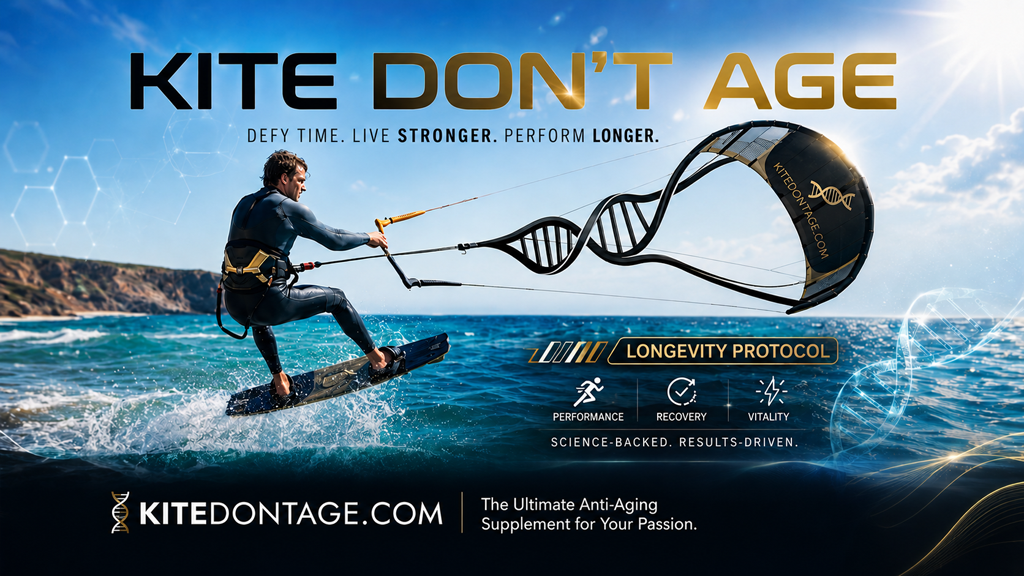
True longevity requires an integrated approach. Supplements solve the cellular riddle, but how you train, eat, sleep, and ride completes the ultimate performance loop.
Heavy landings, explosive unhooked pops, and continuous wind-load demand a bulletproof frame. This custom anti-lordosis, harness counter-balance, and joint-shielding blueprint is engineered to protect your spine, knees, and ribs from heavy impact and massive overpower.
Desk work locks up hip flexors and shuts down glutes—a recipe for severe lower back compression when getting pulled by a kite. Break up your workday every 1–2 hours with these quick, friction-free movements to keep your nervous system primed and joints lubricated:
Run through this movement block daily to stabilize your spine against harness pull and reinforce your landing gear:
| Exercise & Volume | Target Mechanism | Biomechanical Cues & Benefits |
|---|---|---|
| 1 Min Front Plank | Anti-Extension & Pelvic Control | Actively tuck tailbone into posterior pelvic tilt ("ribs to hips"). Do not allow lower back to sag or arch. |
| 1 Min Side Plank (L / R) | Lateral Core & Ribcage Armor | Lock bottom glute and press ground away through elbow. Creates a protective lateral muscle shield around ribs. |
| 40 Dead Bugs | Deep Core Anti-Extension | Non-negotiable: Lower back pressed flat against floor. Scale reach depth if back lifts off ground even slightly. |
| 40 Bird Dogs | Anti-Rotation & Posterior Chain | Extend leg no higher than hip height to prevent lumbar hinge. Keep hips square and level throughout. |
| Glute Bridges (20 Bilateral / 10 Single-Leg) |
Pelvic Realignment & Glute Activation | Drive through heels and finish lockout purely with glutes without arching lower back. Counters harness anterior pelvic pull. |
| 10 Pull-ups OR Chin-ups (Alternate Days) |
Upper Body Pulling Framework | Builds elite lat and grip strength for total bar control and sustained unhooked driving power. |
| 30 Push-ups (Every Second Day) |
Push Endurance & Shoulder Armor | Keeps your shoulders balanced, stable, and completely resilient during high-velocity crashes and water restarts. |
1x Weekly Isometric Boost (Non-Kiting Day): Perform 2-minute holds for Front Plank, Side Planks, and Wall Sit + Block Squeeze to build tendon stiffness, trigger vascular nitric oxide release, and condition mental stamina for overpowered holdouts.
Heavy Kiting Days (Post-30kts / Big Boosts): Cut static core volume by 50% (30s planks, 20 dead bugs). Prioritize 100% volume on T-Spine Rotations, Glute Bridges, and Hangs for a spinal reset.
Injury Cues: If experiencing an end-range knee pinch after heavy landings, avoid deep flexed squats for 48 hours and rely on Wall Sit block squeezes while joint effusion settles.
Commit to the maintenance daily. Keep your frame ready so that when the wind turns on, you never have to hold back.
Stiff muscles tear under load; elastic tissues absorb impact and bounce back. Traditional static stretching alone fails because your nervous system forces defensive muscle bracing when your joints track off-center. To build bulletproof mobility for radical tacks and high-flying rotations, we follow a precise neurological sequence: Clear the joint space, activate dynamic sliding surfaces, expand length safely, and lock in end-range strength.
Before diving into advanced hip mechanics, we must release the intense spine compression caused by hours under a loaded kite harness. Use these classic foundations to reset your vertical column balance:
Run this master sequence to permanently open up your range of motion. Crucial Breathing Protocol: Throughout the deep holds, use a strict 4-second nasal inhale to an 8-second relaxed exhale. This down-regulates the sympathetic nervous system and coaxes defensive muscle tension to melt away.
Protocols:
The Kinetic Goal: Centers the femoral head perfectly inside the hip socket, clearing physical pinch points and immediately shutting down deep groin muscle bracing.
Protocols:
The Kinetic Goal: Floods the joint capsules with lubricating synovial fluid, fires up deep external stabilizers, and preps muscle sliding surfaces without accumulating fatigue.
Protocols:
The Kinetic Goal: Exploits newly cleared joint spaces under a down-regulated, calm nervous system to safely lengthen deep adductors and stubborn fascial lines.
Protocol:
The Kinetic Goal: Passive flexibility is volatile. Producing active force at your absolute edge updates your brain's neurological blueprint, ensuring this deep range is permanent and stable. This completely eliminates next-day rebound stiffness.
Clean the alignment, protect your articular cartilage, and own your movement space.
Eliminate ultra-processed foods entirely. To mitigate systemic oxidation from intense sun, salt, and heavy physical impacts, your nutrition must focus on premium structural repair, anti-inflammatory defense, and strategic metabolic fasting blocks that trigger deep cellular cleanup (autophagy).
Incorporate these specific whole-food powerhouses into your regular diet to actively accelerate healing:
Every second month, execute a structured 40-hour deep water fast if your schedule allows. This is the ultimate "reset switch" for your body:
Extended fasting starves out dysfunctional cells and forces your body to execute severe internal housekeeping—sweeping away damaged proteins, clearing out toxic cellular debris, and triggering a surge in stem cell regeneration.
*Crucial Note: Throughout this protocol, and especially during high-wind season, drink a massive amount of clean water enhanced with high-quality electrolytes or unrefined sea salt to flush toxins, maintain blood volume, and keep your joint cartilage fully hydrated under high G-forces.
Give your body the premium materials it needs to rebuild, and the fasting space it needs to clean up.
Sleep is your single greatest organic performance enhancer. Guard your sleep cycles viciously. Optimizing deep and REM sleep stages maximizes human growth hormone production, clearing out systemic inflammation and preparing your nervous system to handle the next day's massive session.
Defend your nights so you can attack your days on the water.
Longevity on the water requires mitigating variables before your feet ever touch the straps. By merging strict risk assessment, real-time wind adaptation, and structural load reinforcement, you eliminate reckless exposure and ensure your hardware matches the day's physical demands.
Dial your gear, read the conditions, and minimize risk before you pull the trigger.
Longevity is dictated by your mental baseline. If you view every session through a lens of frustration about what you can't do, you build mental tension. Shifting to an intentional practice of tracking goals and expressing appreciation anchors your progression in reality.
Appreciate the tricks you already have in your bag instead of obsessing over what's missing. Cultivate a relentless appreciation for simply being on the water: remember that every single session is infinitely better than a session spent on the sofa.
Write down what you are grateful for every single day. Keeping a physical script of your wins, your health, and the conditions keeps your perspective grounded, stable, and highly resilient when injury or poor wind seasons hit.
Write down exactly what tricks you want to conquer next. Do not leave them as vague ideas. Map them out on paper and systematically break them down into their component parts—board edge, kite position, pop mechanics, and release. Small, structured targets prevent overwhelming your system.
You are the average of the riders you surround yourself with. Isolation slows your growth, while the wrong crowd introduces reckless risk. Curating your immediate kiteboarding network is a fundamental tactical longevity move.
Viciously filter who you hit the beach with. Surround yourself with positive, stoked people who genuinely love the sport. Energy is highly infectious; riding with people who laugh off mistakes keeps your own mental state perfectly light and loose.
Seek out riders who are just slightly more advanced than you are. Riding with pros can be demotivating, but partnering with peers who can push you just a fraction past your comfort zone creates a healthy, collaborative competitive fire that accelerates safe progression.
Stop trying to brute-force complex maneuvers through blind trial and error. Utilizing structured, expert coaching breaks bad muscle memory patterns immediately, keeps you accountable to your written goals, and protects your body from catastrophic, unguided crashes.
Never let the pressure to perform kill the stoke that got you into the water in the first place. While pushing your limits, mastering complex unhooked maneuvers, and fueling a bit of competitive fire keeps things sharp, having fun must remain your absolute priority. Longevity isn't just about preserving your joints—it's about preserving your raw enthusiasm.
Approach every single session with a beginner’s curiosity. If you are constantly stressing about landing a trick perfectly or comparing your progress to others, you introduce psychological tension—and a tense mind leads to a rigid, injury-prone body.
Wiping out isn't a failure; it’s a sign that you are actively learning and playing at the edge of your comfort zone. Laugh off the spectacular crashes, enjoy the process of trial and error, and view the water as a playground rather than a testing ground.
A playful mind naturally prevents burnout. When you decouple your self-worth from your athletic output, you allow yourself to ride for decades without losing the passion. Protect your mental stoke just as viciously as you protect your physical frame.
Keep the fire playful, stay loose, and enjoy every single loop.
The protocols on this site, tested in real wind. Our newest Kitehomiez episode:
Deep-dive weekly breakdowns on the engineering, biology, and tactical strategy behind staying on the water forever.
New country, new food, three sessions a day. Why your gut controls recovery and inflammaging, and the simple protocol that keeps you on the water on every kite trip.
The water doubles your UV dose. The layered skin protocol, the right eyewear, and the trial showing daily sunscreen slows visible aging.
Muscles adapt in weeks, but tendons take months. Here are the exact exercises, tempos, and protocols to bulletproof your joints against extreme wind loads.