
Every kiter who chases wind around the world knows the story: you finally land at the spot, the forecast is perfect, and on day two you're stuck near a bathroom instead of on the water. Traveler's stomach trouble is so common that the CDC estimates it hits 30 to 70% of travelers, depending on destination and season.
But the gut matters far beyond a ruined trip. The trillions of bacteria living in your intestines (your microbiome) help digest your food, train your immune system, produce vitamins and signaling molecules, and guard the barrier between your bloodstream and everything you eat. When that system breaks down, the result isn't only bloating. It's inflammation, and inflammation is one of the main engines of aging.
1. Inflammaging: Where the Gut Meets Longevity
Researchers use the term "inflammaging" for the chronic, low-grade inflammation that rises as we get older. It's linked to stiffer joints, slower recovery, weaker immunity and most age-related disease. The gut is one of its biggest sources:
- A leaky barrier: Your intestinal lining is a single layer of cells. When it gets damaged, bacterial fragments slip into the bloodstream and keep the immune system on permanent low alert.
- Lost diversity: Microbiome diversity tends to decline with age, antibiotics, stress and low-fiber diets. Fewer species usually means fewer of the bacteria that produce anti-inflammatory compounds like butyrate.
- The centenarian clue: Studies of very long-lived people in Italy and Japan have found that they carry distinctive gut communities, often richer in bacteria linked to healthy metabolism and lower inflammation.
The Hard Session Effect
Long, intense exercise in the heat diverts blood away from your gut toward your muscles and skin. Sports scientists have measured that this temporarily increases gut permeability: the barrier gets leakier during and after hard efforts. Add dehydration, salt water swallowed in crashes, and unfamiliar food on a kite trip, and you have the perfect setup for gut trouble exactly when you want to be riding.
2. Why Your Recovery Runs Through Your Gut
In The Anti-Fragile Kiter we covered how riding for decades depends on tissues that can repair themselves after heavy loading. That repair depends on what you absorb and how much background inflammation you carry:
- Nutrient absorption: Protein, minerals and the collagen building blocks your tendons need only help if your gut actually absorbs them.
- Immune resilience: A large share of your immune tissue lines the gut. A Cochrane review found that people taking probiotics had fewer upper respiratory infections. That's a big deal when a cold can cost you a week of wind.
- Energy and mood: Gut bacteria help produce B vitamins and talk to your brain through the gut-brain axis. A disrupted gut often shows up first as low energy and poor sleep.
3. The Traveling Kiter's Gut Protocol
None of this needs to be complicated. These are the habits that do the heavy lifting:
1. Eat 30 Plants a Week
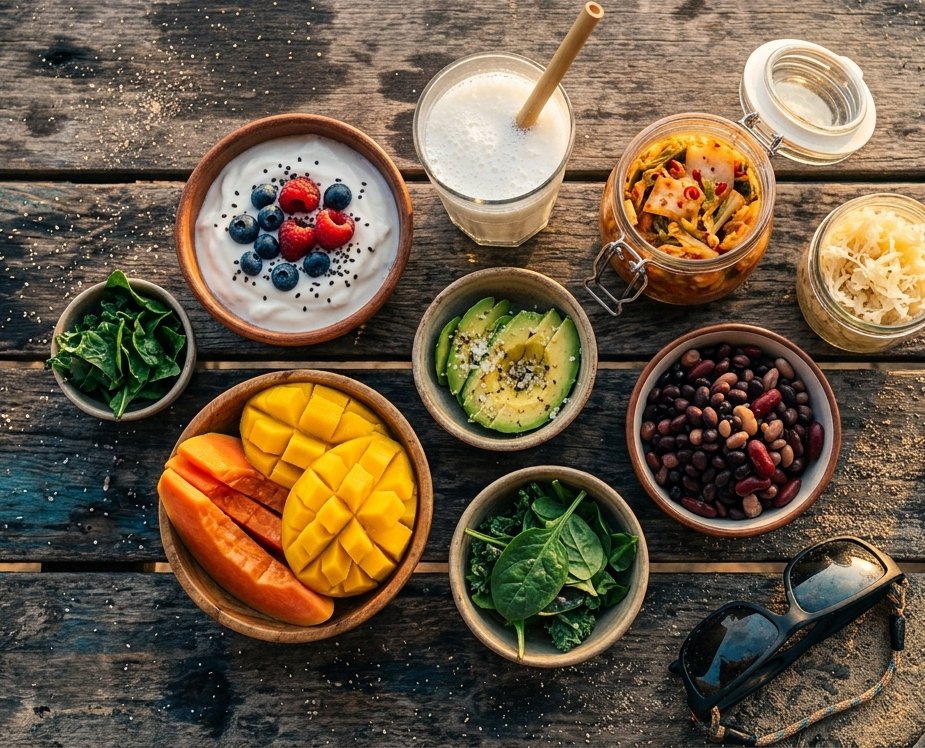
Data from the American Gut Project showed that people who ate 30 or more different plant types per week had more diverse microbiomes than those eating 10 or fewer. Every new vegetable, legume or herb counts. Kite trips are actually a great chance to do this: local markets, new fruit, new spices.
2. Fermented Food Every Day
In a 2021 Stanford study (Wastyk et al., Cell), adults who ate a high-fermented-food diet for 10 weeks increased their microbiome diversity and showed lower levels of 19 inflammatory markers, including IL-6. A small daily serving is enough.
3. Travel-Proof the Basics
Drink bottled or filtered water where tap water isn't safe (that includes ice and rinsed salads), choose hot, freshly cooked food, and replace the salt and fluid you lose riding in the heat. The classic rule still holds: boil it, cook it, peel it or forget it.
4. A Daily Probiotic, Started Before You Fly
This is the easiest habit on the list and one of the most powerful. A quality multi-strain probiotic tops up the good bacteria every single day, so your gut walks into a trip strong instead of fragile. Research on travelers has found that probiotics can lower the risk of traveler's diarrhea, and a well-stocked microbiome handles new food, stress and hard sessions far better. On antibiotics? Keep taking it, just two hours apart from the antibiotic dose, and keep going after the course to help your gut rebuild.
4. My Own Story (Yes, We're Talking Digestion)
I'll be honest: this isn't something I usually talk about. For about ten years I lived with IBS and slow, sluggish digestion. Some weeks were fine, many weren't. On one kite trip to the Dominican Republic my system basically shut down for a whole week, which is not how you want to spend a wind season.
I tried the usual pharmacy probiotics, Align included, without much change. What finally worked for me was a simple daily combination: 2 to 3 tablespoons of ground flax, chia and psyllium husk (with plenty of water), a bit of magnesium, and the DoNotAge Probiotic. Within a few weeks of starting the probiotic, my digestion became regular and predictable for the first time in years, and it has stayed that way ever since. After a decade of trying things, I'm convinced the DoNotAge Probiotic was a huge part of the turnaround.
Today it's one of the two products I take every single day (the other is the 15x1 sachet). One capsule has 30 billion live cultures from 10 strains (6 Lactobacillus and 4 Bifidobacterium), plus inulin, a prebiotic fiber that feeds the good bacteria, and a little vitamin B12. It's vegan, dairy-free and temperature-stable, which matters when your bag sits in a 35-degree beach shack for two weeks. One jar lasts a full year, so it comes with me on every trip.
Pair it with the food habits above and you've got the full system: fiber and fermented food build the garden, and the probiotic keeps it stocked with the right bacteria every day, wherever the wind takes you.
Protect Your Second Engine (10% Off)
The Probiotic is my number one recommendation for any kiter who travels. Grab it (and the 15x1 daily sachet) from the DoNotAge range. Use discount code KITEHOMIEZ at checkout for 10% off your entire order.
Shop DoNotAge Probiotic →This article is for general education and isn't medical advice. Talk to your doctor before starting a supplement, especially if you are pregnant, immunocompromised or taking medication. Some links on this page are affiliate links: if you buy through them, we earn a small commission at no extra cost to you.